International Outbound Calling for AI Voice Agents: What Actually Matters
International Outbound Calling for AI Voice Agents: What Actually Matters
Why international outbound is hard for AI voice agents, what a good global SIP trunk needs (A-Z routes, CLI, per-second, HLR), and how to keep answer rates healthy.
Why is international outbound hard for AI voice agents?
Most AI platforms bundle telephony from a single, US-centric provider. That's fine for domestic calling, but internationally it tends to mean three problems:
- Patchy coverage and quality. Routes to emerging markets in Africa, the Middle East, and parts of Asia are often expensive, low-quality, or simply unavailable from a US-first provider.
- Caller ID that doesn't land. A foreign or mismatched caller ID gets ignored or flagged, so answer rates fall.
- Cost that doesn't scale. Per-minute billing with markups punishes the short, high-volume calls typical of outbound AI campaigns.
The fix is to bring your own carrier for the outbound leg — a carrier built for international termination — while keeping your AI platform for the conversation.
What do you need for good international AI calling?
- A‑Z termination quality in your target countries, not just a global average. Ask about routes to the specific regions you call.
- Valid local caller ID (CLI) you're authorized to present, so calls look legitimate to the recipient.
- Per-second billing so short calls aren't rounded up to a full minute.
- HLR lookup / number validation to drop disconnected or ported numbers before you dial them.
- Elastic concurrency for campaign spikes, and E.164 number formatting everywhere.
- Compliance with local rules (consent, calling hours, disclosure) in every market you dial.
What's the difference between CLI and NCLI routes?
You'll see carriers advertise CLI and NCLI routes — it matters for both answer rates and compliance:
- CLI routes preserve the caller ID end to end. The recipient sees the number you set. These are higher quality and usually the right choice for legitimate, branded outbound — better trust, better answer rates.
- NCLI routes don't guarantee the caller ID is delivered (it may be changed or dropped). They're typically cheaper, but the missing/altered caller ID hurts answer rates and can create compliance problems.
For AI voice agents talking to real customers, CLI routes with a valid local number are almost always the better choice, even at a slightly higher per-minute rate, because answer rate is what actually drives campaign ROI.
How do you keep answer rates healthy on outbound AI calls?
- Present a valid, local caller ID for the region you're calling, instead of a foreign number.
- Validate lists with HLR so you skip dead numbers and protect your route reputation.
- Respect time zones and calling windows in each market.
- Get consent and follow local regulations (in the US, that's TCPA-style consent rules; other countries have their own). This isn't legal advice — confirm the rules for each market you operate in.
- Keep the media path clean. International calls add latency; choose routes close to your AI platform and use G.711 to avoid transcoding. (If calls drop around the 30‑second mark, that's an RTP keepalive issue — see AI voice calls dropping after 30 seconds.)
How Bitcall fits for international AI outbound
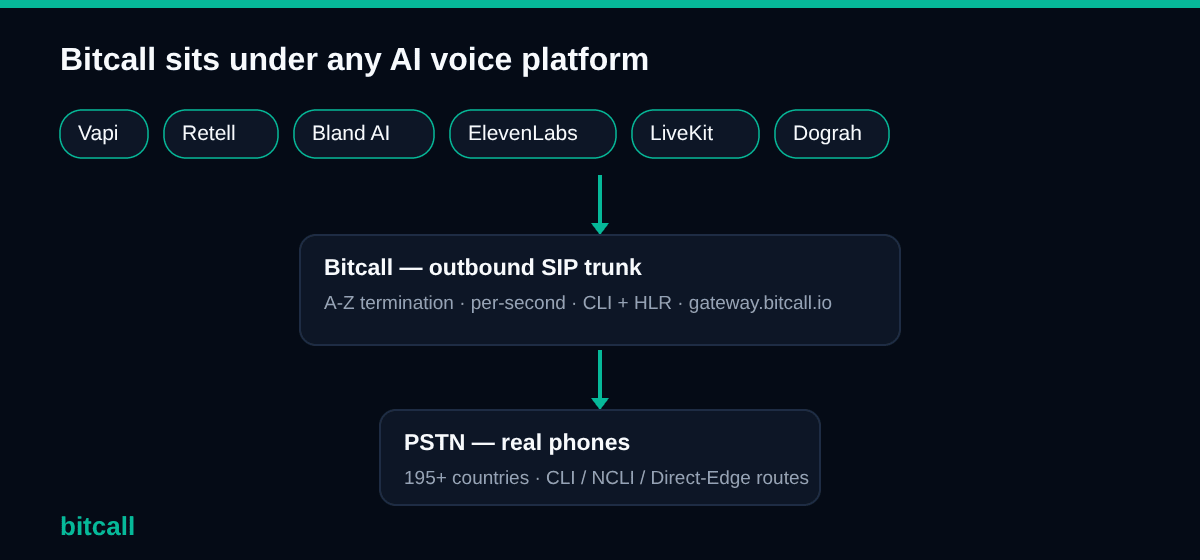
Bitcall is a self-service telecom platform built for outbound termination — the carrier layer beneath your AI agent:
- A‑Z termination from $0.01/min with per-second billing to 195+ countries, with CLI, NCLI, and Direct‑Edge routes and genuine strength in Africa, the Middle East, Asia, and Europe — exactly the markets US-first providers serve poorly.
- Caller ID (CLI) control and HLR Lookup to keep campaigns clean and answer rates healthy.
- No contracts, no minimums; prepaid top-ups by card, PayPal, or crypto.
- SIP-native with SRTP/TLS.
Scope today: Bitcall powers outbound calling. Inbound numbers (DIDs) are on the roadmap.
Bitcall sits underneath whichever agent stack you use — see the setup guides for Vapi, Retell, Bland, ElevenLabs, LiveKit, and Dograh.
FAQ
Can AI voice agents make international calls? Yes — but the platform's bundled telephony is usually US-centric. For reliable global outbound, connect your own international carrier (BYOC) for the outbound leg.
What's the best caller ID strategy for international outbound? Present a valid local caller ID you're authorized to use for the destination region. Local CLI lands better than a foreign number, which lifts answer rates — and keeps you compliant.
Why are my international AI calls expensive? Bundled per-minute telephony with markups is costly at scale. A direct A‑Z carrier with per-second billing usually cuts the per-call cost substantially.
Do I need different routes for different countries? Effectively yes — route quality varies by destination. Choose a carrier with strong, specific coverage in the markets you call, not just a good global average.
Related resources
Why OTP Verification Fails (And How to Build a Reliable SMS Verification System)
Dograh + SIP Trunking: Outbound Calling for a Self-Hosted Voice Agent
Related posts
Best Outbound SIP Trunk Providers for AI Voice Agents (2026)
Dograh + SIP Trunking: Outbound Calling for a Self-Hosted Voice Agent
Vapi Outbound Calling: How to Use Your Own SIP Trunk (and Why)
Auf dieser Seite
Why is international outbound hard for AI voice agents?
What do you need for good international AI calling?
What's the difference between CLI and NCLI routes?
How do you keep answer rates healthy on outbound AI calls?
How Bitcall fits for international AI outbound
FAQ
Related resources
Bitcall Team
authorBrauchst du weitere Hilfe?
Du findest nicht, wonach du suchst? Unser Support-Team hilft gerne.
Kontaktiere uns